Request Sent a Appointment
Services
CT Scan (Computed Tomography Scan)
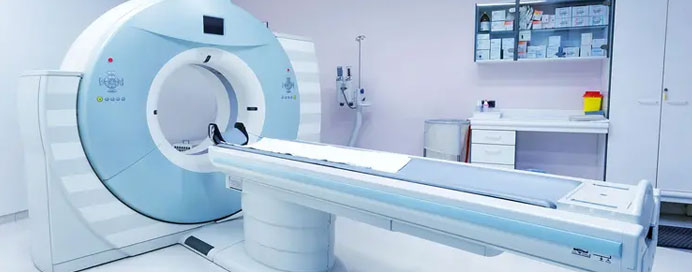
A CT Scan (Computed Tomography Scan) is an advanced medical imaging technique that combines X-rays with computer technology to create detailed cross-sectional images of the body. Unlike a regular X-ray, which shows only flat images, a CT scan produces 3D-like images of bones, soft tissues, and blood vessels, giving doctors a much clearer view of internal structures. It is widely used for diagnosing injuries, infections, tumors, internal bleeding, strokes, and various diseases in the brain, chest, abdomen, and pelvis.
The procedure is quick, painless, and non-invasive. During the scan, the patient lies on a table that slides through a circular CT scanner. In some cases, a contrast dye may be given orally or intravenously to highlight specific organs, blood vessels, or abnormal tissues.
Key Features & Benefits of CT Scan
Detailed Imaging – Produces high-resolution images of bones, organs, and soft tissues.
Fast & Accurate – Scans can be completed within minutes, useful in emergencies like accidents or strokes.
Wide Applications – Detects tumors, fractures, infections, blood clots, and internal injuries.
Guidance for Treatment – Helps doctors plan surgeries, biopsies, and radiation therapy.
Non-Invasive – Provides internal images without surgical procedures.
Common Uses of CT Scan
Brain – Detects stroke, tumors, bleeding, and trauma.
Chest – Identifies lung infections, cancers, pulmonary embolism.
Abdomen & Pelvis – Evaluates liver, kidneys, pancreas, intestines, and reproductive organs.
Bones & Joints – Finds fractures, bone tumors, and spinal problems.
Blood Vessels (CT Angiography) – Examines arteries and veins for blockages or aneurysms.
Advantages of CT Scan
High-speed results (critical in emergencies).
More detailed than standard X-rays.
Can scan nearly any part of the body.
Helps in early disease detection.
Scope of CT Scan Studies
CT Studies
- CT Brain
- CT Paranasal sinuses
- HRCT Temporal Bone
- CT Orbits
- CT Facial bones
- CT Neck
- HRCT Chest
- CECT Chest
- CECT Abdomen
- CECT Pelvis
- CECT Abdomen and Pelvis
- CT Triple phase Liver
3D Scan Joints
- Shoulder joint
- Elbow joint
- Wrist Joint
- Hand
- Hip Joint
- Thigh
- Knee Joint
- Leg
- Ankle
- Foot
CT Angiography Studies
- CT Brain Angiography
- CT Neck (Carotid and Vertebral) Angiography
- CT Brain and Neck Angiography
- CT Pulmonary Angiography
- CT Aortography
- Thoracic Aorta
- Abdominal Aorta
- Thoracic and Abdominal Aorta
- CT Renal Angiography
- CT Abdomen and Pelvic Angiography
- CT Superior Mesenteric Angiography
- CT Upper Limb Arterial Angiography
- CT Lower Limb Angiography
- CT Upper Limb Venography
- CT Lower limb Venography
- CT Colonography with Virtual Coloscopy
- CT Bronchography with Virtual Bronchoscopy
- 3D CT Ribs with Unfolding of ribs
- CT Urography / KUB
- Plain
- Plain + Contrast
- Whole body CT Scan
3D CT Scan Spine
- Cervical spine
- Dorsal Spine
- Lumbosacral Spine
- Sacrococcyx Spine
- Whole Spine CT